
Deep Foundations and Piers in Colorado Springs
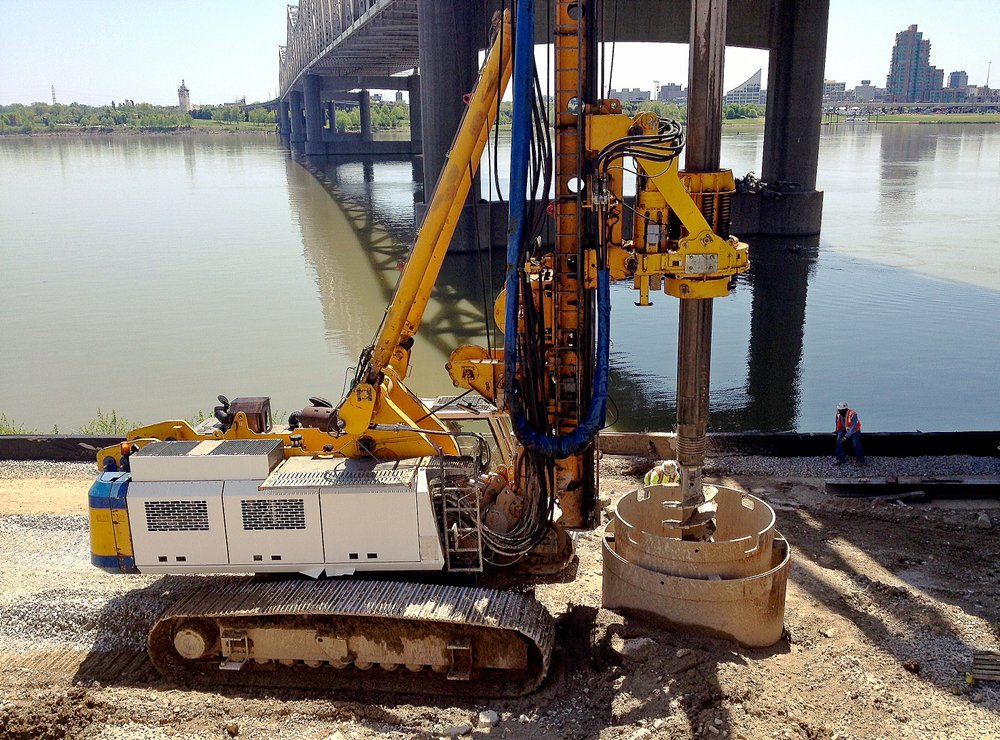
The ground beside Fountain Creek is not the ground on the mesa above it, and a building that treats them the same pays for it in settlement. Deep foundations carry load past weak or variable soil to material that can hold it, and the choice between driven piles, helical piles, micropiles and drilled shafts depends on what lies below. We build deep foundations for industrial structures in the Colorado Springs metro, working from the geotechnical report and the structural engineer's loads.
The metro's water corridors show why subsurface knowledge matters. Fountain Creek, a 74.5-mile creek with a watershed of about 930 square miles, begins in Woodland Park and runs through El Paso County to the Arkansas River near Pueblo, and it runs alongside Interstate 25 from about exit 119 through Widefield. Sand Creek, one of its key tributaries, needed a $5 to 6 million repair in 2018 to reshape about half a mile of channel south of the Platte Avenue bridge. Sites in these corridors deal with alluvium, groundwater and flood exposure that sites on higher ground do not.
We treat the pier or pile as a structural element that must be installed within tolerance, tested where required and documented. A foundation is invisible once the building stands, so the record of how it was built is as important as the foundation itself. For the most common shaft method, see our drilled pier foundations work.
Reading the Soil Before Choosing the System
The geotechnical report is the contract's most valuable document. It identifies bearing layers, groundwater, expansive or collapsible soil, bedrock depth and recommendations for each foundation type. We read it in preconstruction and walk the site with the engineer, because a boring log describes a point and the building covers an area.
When conditions vary across the footprint, we propose a mixed system or a design that allows for the variation, with clear unit prices for added depth. That arrangement prevents disputes over rock, cobbles or water, the three conditions that most often change the price of deep foundation work. The preconstruction process is explained under our preconstruction services.
Why Deep Foundations Come Up Here
Parts of the metro are a mix of creek alluvium, foothill rock and rolling upland, and industrial buildings are placed on all of them. Security-Widefield, an unincorporated community of 38,639 residents that lies along I-25 near the creek, is typical of the transitional ground south of the city. The sites that produce heavy buildings with large column loads, crane runways and tall racks are the ones that most often justify deep foundations.
Flood and debris risk affect the design as well. After the Waldo Canyon Fire, about 3,375 acres burned severely enough to raise the risk of debris flows for at least 10 years, and that kind of event can scour channels and change the ground near them. We confirm flood exposure and scour depth with the engineer before choosing pile length.
Systems We Install
We install drilled shafts with casing where needed, driven steel or concrete piles, helical piles for lighter loads and quick installation, and micropiles where access is limited or the ground is variable. Pile caps, grade beams and pier caps are formed and poured as part of the same package, with anchor bolts and embedded plates positioned for the structure above.
Tests are part of the scope: static load tests, integrity tests, drilling logs and installation records. We deliver the records to the engineer on a rolling basis so any deviation from the design is caught early, not after the foundations are covered.
Working Around Rigs, Spoils and Groundwater
Piling rigs are heavy, tall and noisy, and the ground around them must be stable. We build a working platform for the rig, set an exclusion zone and keep underground utilities located and marked before drilling. Spoils are stockpiled away from open excavation and removed on a plan, and groundwater is handled with pumping and filtration so discharge meets the permit.
Noise and vibration also deserve planning when the site is next to occupied buildings. We monitor vibration at the property line when required, and we choose methods that reduce impact. Near the airfield, rig height is coordinated with airport rules.
What Makes Deep Foundation Cost Change
The main variables are the number of piles or shafts, depth, diameter, the presence of rock, groundwater, casing and testing. Mobilization of a rig is a large fixed cost, so a few large piers can cost proportionally more than a larger count of shallow ones. Unit prices for extra depth and for rock coring give both sides a fair way to handle variation.
We also price the value of speed. A system that installs quickly, such as helical piles, can cost more per element but save weeks on a schedule that has a tenant waiting. Owners building a manufacturing plant or a warehouse building weigh that trade at the start.
Related Scopes
Deep foundations lead directly into tilt-wall industrial buildings and structural steel framing, where column loads are heaviest. They also appear under tall equipment and crane-supported structures. Owners in metals and heavy industry often combine them with equipment foundations for process lines.
We schedule foundations to give the structure a clean start, with caps cured and surveyed ahead of erection.
Match the Foundation to the Ground
Send the geotechnical report and the column load plan, and we will propose a system, a count and a schedule with unit prices for variation.
Common Questions
How do I know whether my site needs deep foundations?
The geotechnical report answers that question. It compares the soil bearing capacity with the building loads and identifies weak or variable layers. If shallow footings cannot meet the settlement limits, the engineer recommends piles or piers.
What is the difference between piles and drilled piers?
Piles are driven or screwed into the ground and displace or compact the soil, while drilled piers are made by removing soil and placing concrete in the hole. Piers suit rock and dense soils and carry large loads in one element. Piles suit softer ground and fast installation.
What happens if we hit rock or groundwater?
The contract should define unit prices for added depth, rock coring and dewatering, so cost is not argued after the fact. We log each element and notify the engineer immediately. The engineer then confirms the adjustment.
How long does deep foundation work take?
Duration depends on the count, depth and method. Small helical piles install in minutes each, while large shafts take a day or more. We provide a production rate in the bid and update it after the first elements are installed.
Is testing required?
The engineer defines it. Static load tests, integrity tests and installation records are common on larger or critical structures. We include the testing in the schedule so results do not delay the caps.