
Industrial Site Utilities Package in Colorado Springs
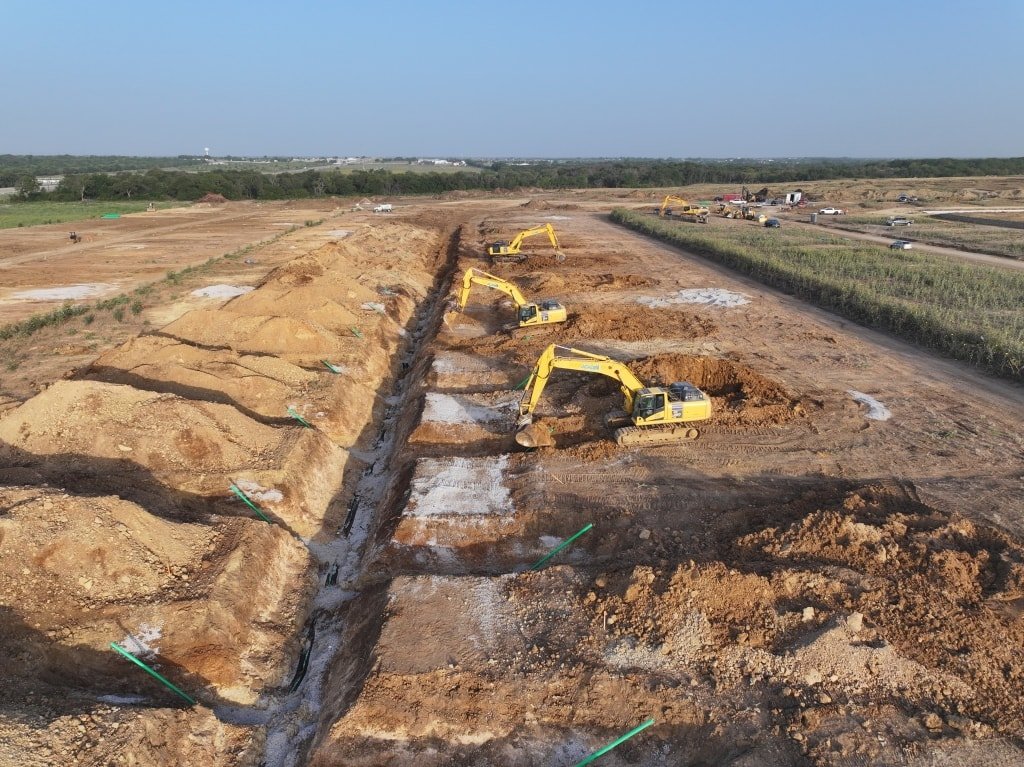
Underground work is the part of an industrial project nobody sees and everybody depends on. Water, sanitary sewer, natural gas, electric service, telecommunications and fire water all have to reach the building at the right depth and in the right order, before the pad is finished and the paving goes down. In the Colorado Springs metro the providers differ from place to place, creeks cross the routes, and the cost of a mistake in the ground is measured in re-excavated pavement. We install industrial site utility packages as a single, sequenced scope, so nothing is buried before it is inspected and nothing is paved over before it is tested.
The package starts at the connection points each provider has approved and runs to the building and the yard: service laterals, mains and sub-mains, valves, meters, vaults, manholes, cleanouts and thrust restraint. We coordinate with the electric duct bank, the fire water loop and the drainage so crossings are planned, not discovered.
Utilities included in the package
Domestic and process water service, sanitary sewer and interceptors where the use requires them, natural gas, telecommunications conduit and the pad for the transformer are the core of the package. Fire water and electric duct banks are often separate scopes with their own inspectors and are coordinated with ours: see fire water loop and hydrant systems and electrical duct bank and underground work.
We pothole existing utilities before trenching, lay out each run from the survey and keep a daily record of depth, bedding, joints and test results. Trench safety is part of every run: shoring or sloping to the engineer's design, a competent person on site and utility locates renewed on a schedule.
Every valve, curb stop, cleanout, manhole and meter vault is surveyed for location and elevation as it is set and tagged on the as-built drawings, so that your maintenance staff can find and operate it years later without probing the pavement. Where a secured site restricts surveying equipment or photography, we agree the method with your security staff in advance.
Crossings, depth and the provider's rules
Each provider has its own standards for materials, depth, separation, clearances and who may do the work. Some require the utility's own crews to make the final tap or connection to the main; others allow the contractor to do it under inspection. We obtain the standards early, build them into the drawings and schedule the utility's own work as a dependency, not an assumption.
Creeks complicate the routes. Fountain Creek runs alongside Interstate 25 from about exit 119 through Widefield, and Fountain sits on the creek at an elevation of 5,558 feet, so a service run near Security-Widefield may meet floodplain, groundwater or a creek crossing. We investigate groundwater and crossing requirements before pricing and plan dewatering, casing or boring where they are needed.
What we manage most closely
We schedule and inspect trenching, bedding, pipe installation, structure setting, backfill and compaction for site utilities, which lets us control the sequence and the quality of work that will be buried. Subcontractors handle specialty items such as directional drilling, tap-and-sleeve connections and high-pressure testing under our supervision.
The advantage is accountability. When the same company that dug the trench also tested the line and restored the surface, a leak or a settling trench has one owner. We deliver as-built records with surveyed inverts and locations to the owner and the utility, and we place conduit and pull boxes for yard lighting and electrical site work in the same trench window so the yard is not opened twice.
Underground before paving
Underground work is the gate to everything above it. Utilities go in after rough grade and before the building slab for anything that enters under the floor, and before base course and paving for anything in the yard. A late connection approval or a failed pressure test pushes paving and, in the cold season, can push it into the following spring. We therefore schedule tests and inspections as activities in the plan, not as afterthoughts.
Electric service is often the longest item. On June 13, 2025, Colorado Springs Utilities and the airport signed an agreement to build electric, gas, water and wastewater infrastructure for Peak Innovation Park, including a transmission framework of up to 600 megawatts and a new high-voltage substation, with about $58 million from the airport and $165 million from Utilities. Large extensions at Colorado Springs Airport show that infrastructure timelines are set by the provider, and the building schedule has to be fitted to them.
Providers across the metro
Utility providers vary across the area we work in. Colorado Springs Utilities serves the city. In Woodland Park, IREA, the area's main electric utility, is based in the city, and the town sits at 8,481 feet, so cover depths and cold-weather practice differ from those in the city. Interstate 25 serves Monument at exits 158 and 161 and State Highway 105 runs through the town, so crossings of those corridors involve additional agencies.
We confirm each provider's requirements before pricing and keep a provider directory for the project with contacts, standards and inspection procedures. Owners with heavy electric or process loads should talk to the provider before choosing a parcel; our experience on utilities and power projects shows how much of the schedule that conversation controls.
Settle the underground first
Share the site plan and the provider contacts. We will return a utility package with connection points, crossings, testing and a sequence that gets the paving started on schedule.
Common Questions
Who connects the service to the utility main?
It varies by provider and by utility type. Some utilities perform the final tap with their own crews, others allow the site contractor to do it under inspection. We confirm the rule for each service at the start and schedule the utility's work as a milestone with a lead time.
How early do utility availability letters matter?
Very early. A letter confirms capacity, the connection point and any fees or upgrades required, and it can change the cost of a parcel. We request them during preconstruction, before the site plan is final, so the extension costs are known before design is committed.
What testing is done before the trench is closed?
Pressure and bacteriological testing for water, air or water testing and televised inspection for sewer where required, and inspection of bedding, depth and joints. Each test is witnessed or recorded as the provider requires, and we hold the backfill until the result is accepted.
How do you handle crossings of other utilities?
We locate and pothole them before trenching, document the clearances on the as-builts, and coordinate the crossing with the owning utility when it requires a witness. Conflicts discovered in the field are resolved with the engineer, and the new routing is recorded.