
Drilled Pier Foundations in Colorado Springs
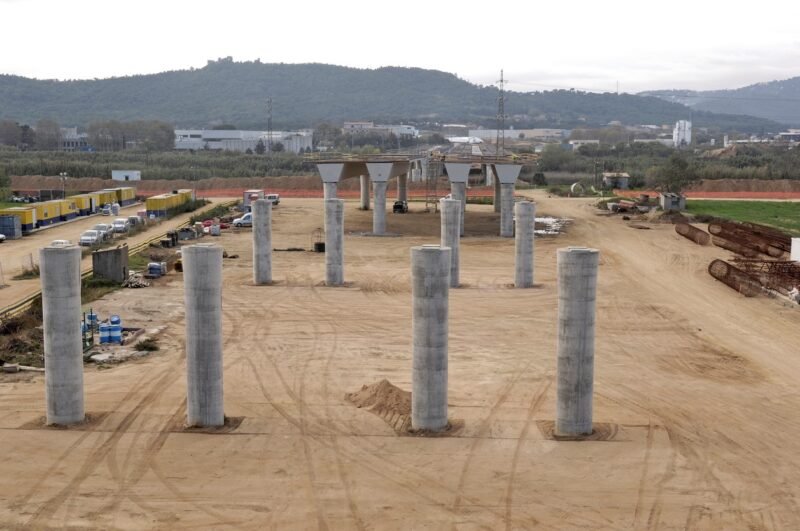
Drilled piers are built by removing the ground, not by displacing it: an auger or a core barrel bores a shaft to bearing, a steel cage goes in and the concrete follows. On the ridge where Monument sits, 6,982 feet above sea level on the southern slope of the Palmer Divide at the base of the Rampart Range, that method gives column loads somewhere solid to land. We drill piers for industrial buildings, crane-supported structures and heavy equipment across the Colorado Springs metro.
Ground changes quickly on a divide. Palmer Lake marks the top of the Palmer Divide, a ridge separating the Arkansas River drainage to the south from the Platte River drainage to the north, and Black Forest, at 7,369 feet to the north of the city, sits in the same upland. Soil layers can change quickly within a single site on ground like this, and the shaft has to be built to the conditions revealed during drilling, not just to the conditions assumed in the report.
We approach each pier as an inspected structure. The rig, the casing, the cage, the concrete and the record are all controlled, because a shaft cannot be seen again once it is poured. A related method, covered under deep foundations and piers, includes piles and micropiles for sites where drilling is not the right choice.
Drilling, Cleaning, Inspecting and Pouring
The sequence for a drilled shaft is simple to describe and unforgiving to perform. We survey and stake each location, set the rig on a stable platform, drill to the design diameter and depth and log the strata as they come up. If caving soil or groundwater is present, casing or slurry holds the hole open. The bottom is cleaned of loose material, and the shaft is inspected before the cage is set.
Concrete is placed by tremie when water is present, and by free fall or a drop chute when the shaft is dry, so it does not segregate. We pour continuously, withdraw casing as the concrete rises and check the volume placed against the theoretical volume of the hole. A shortfall or a surplus tells us about caving or voids before the pier is accepted.
Design Basis, Inspection and Records
The structural engineer designs the shafts from the geotechnical recommendation, and a special inspector observes the work for the building department. Colorado Springs, Fountain and Monument each adopted the 2023 Pikes Peak Regional Building Code, which carries the 2021 International Building Code, and the Pikes Peak Regional Building Department enforces it. Required inspections are listed on the permit, and we do not pour a shaft until the inspector has approved the hole and the cage.
Records include the drilling log, the bottom elevation, the concrete ticket and volume and any testing. We organize them by shaft number so the engineer, the inspector and the owner can find any pier quickly years later. Tolerances for plumbness and position are established in the specification, and we survey each shaft after drilling and again after the cap is formed.
What We Control in the Field
Excavation, reinforcement fabrication, cage placement, forming of caps and grade beams and concrete placement are managed by our project team. Controlling those steps keeps the quality chain intact. The same foreman who watches the drilling log decides whether the cage needs a longer lap and tells the concrete plant how much to send.
We use specialized drilling subcontractors for the largest or deepest shafts and for rock sockets, and we manage them as part of our own program. That arrangement gives you a single point of responsibility and lets us schedule drilling around the rest of the site work, including the access roads described under heavy-haul access roads.
Production Rates and What Slows a Rig
A rig in good ground can finish several shafts in a day. In cobbles, in rock or with groundwater, that rate falls sharply. We state an expected production rate in the proposal, reassess after the first few shafts and tell you immediately if the ground differs from the report.
Weather matters. Wet clay turns a rig platform to mud, and freezing temperatures require concrete protection and heated materials. We build the platform with aggregate and mats, keep the concrete supply warm and avoid starting a shaft we cannot finish the same day. The caps and grade beams follow, and the schedule for structural steel erection depends on those foundations being cured and surveyed.
Shaft Sizes and Applications
Diameters run from small shafts for light structures to large ones for heavy columns and crane runway supports. Belled bases enlarge the bearing area in suitable soil, and rock sockets develop capacity through the shaft wall. Shafts support building columns, tilt-wall panel footings, pipe racks, retaining walls, transmission structures and equipment such as stacks and tanks.
The same technique is used under tilt-wall buildings with poor shallow soils and in utilities and power yards where large transformers and structures bring heavy, concentrated loads.
Where We Drill
We drill across El Paso County and the Pikes Peak region, from the divide near Palmer Lake and Black Forest to the creek corridors and the southern industrial land. On the upland, we plan for mixed soil and, where the report shows it, bedrock at modest depth. In the south, we plan for alluvium and groundwater.
Each area has its own rig access, haul distance and permitting authority, and we confirm them before the schedule is fixed.
Send the Report, Get a Shaft Plan
Provide the geotechnical report and column loads, and we will propose shaft sizes, a production rate and unit prices for rock and water.
Common Questions
How deep do drilled piers need to go?
Depth is set by the engineer from the soil profile and the load, and it can range from a few feet to many times the shaft diameter. The report gives a design depth and a minimum, and the field log confirms or adjusts it. We install to the specified bearing, not just to a number on a drawing.
What if we hit groundwater while drilling?
We use casing or drilling slurry to keep the hole stable and place concrete by tremie so it displaces the water from the bottom up. The inspector confirms the method and the bottom cleanliness. Contracts that include unit prices for these conditions avoid disputes.
How do you handle rock?
Rock calls for core barrels, rock augers or sometimes rock teeth, and it slows production. We identify rock in the report review, price it as a unit item and test the bearing when it is reached. The engineer decides whether a socket is required.
Are drilled piers better than driven piles?
They suit different conditions. Drilled piers work in dense soil and rock and carry large loads in a single element with less vibration. Driven piles are fast and suit soft ground. The geotechnical report and the building loads guide the choice.