
Industrial Demolition Services in Colorado Springs
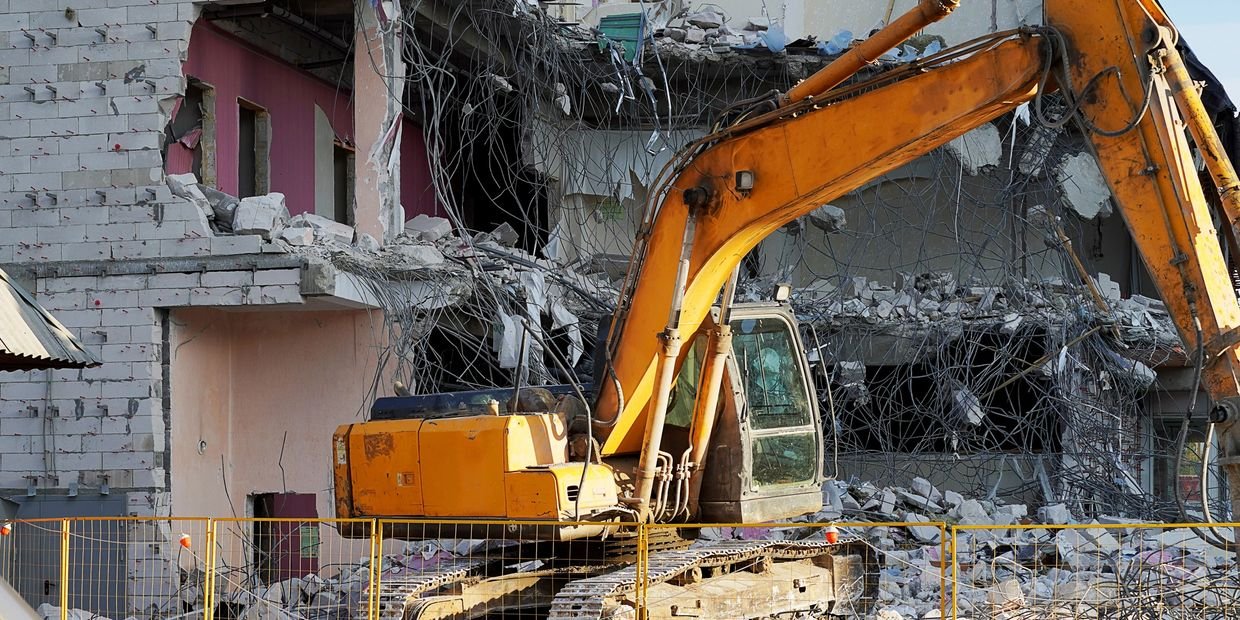
Before anything new goes up, something old comes down, and how it comes down decides how long the new work takes to start. We demolish industrial buildings, structures and equipment: obsolete warehouses and plants, metal buildings, boiler houses, tank farms and process lines, loading docks and the foundations beneath them. We then leave the site graded, drained and ready for the next owner's design, not scraped and left for someone else to sort out.
Industrial demolition is not residential demolition at a larger size. A plant may hold process piping that once carried hazardous materials, insulation or roofing that contains regulated fibers, tanks with residual product, electrical gear with oil, and utilities that must be isolated before a single wall is touched. Every one of these must be identified, tested and handled by the right party before machines enter the building.
Our approach is to plan the demolition as a series of controlled stages: survey, abatement, isolation of utilities, soft strip, structure removal, foundation removal and site restoration. Each stage has a written plan and a record, and each hands the site to the next in a condition the next crew can work in safely.
Sequencing From Survey to Clean Pad
The calendar starts with the surveys, not the machines. A hazardous materials survey of the building is the first item, and its results define the abatement scope and its duration. Utility disconnects follow, which can take weeks when a utility must schedule its crew. Permits are applied for in parallel. Only after those items are complete does the structure come down, and removal of foundations, slabs and below-grade structures follows.
Redevelopment drives the schedule in a growing metro. The Downtown Partnership counted about $1.7 billion in downtown Colorado Springs projects from 2013 to 2020, and a buyer of an older industrial parcel in the metro usually has a development timeline in mind. We build the demolition program to deliver the pad on the date the next contractor needs it, and we give the owner a firm sequence of dates for each stage of work.
What We Remove and How
Soft strip comes first: interior partitions, finishes, ceilings, mechanical and electrical equipment that is salvageable or recyclable. We then take down the roof and walls. Metal buildings are dismantled in the reverse of their erection, with panels, purlins and frames separated for recycling. Masonry and concrete structures are brought down with excavator-mounted shears and breakers, with water for dust control.
Below grade, we remove footings, slabs, pits, sumps, tanks and abandoned utilities, backfill with compacted fill in lifts and grade to the specified surface. Material is sorted on site where possible: steel, aluminum, copper and concrete are recycled, and the rest is hauled to permitted facilities. For the slab-only case, where a building remains, see demolition and slab replacement.
Hazard Control Before and During Demolition
Hazardous materials are handled by licensed abatement contractors working under the survey. Asbestos-containing materials, lead-based coatings, polychlorinated materials in old equipment, mercury switches and refrigerants are removed before the structure is disturbed. We coordinate the abatement schedule and the clearance testing, and we do not begin demolition until the abatement contractor has released the area.
During demolition, the hazards are the structure itself, falling debris, dust and the machinery. We use an engineer's demolition plan for any structure with a complex frame, brace the elements that need it, and maintain exclusion zones around the work. Water or dust suppression is used on every cut and break. Utilities are verified dead and tagged before work begins, and nothing in the building is assumed to be isolated until it has been tested.
Permits, Notifications and Disposal
A demolition permit is required from the building authority. In the metro that is the Pikes Peak Regional Building Department, whose adopted 2023 Pikes Peak Regional Building Code applies in the city, Fountain, Monument and unincorporated El Paso County. State and federal rules govern asbestos and other regulated materials, including notification before work begins. Utilities must confirm that service has been disconnected, and erosion and stormwater controls are installed before ground is disturbed.
Disposal is controlled as well. Regulated waste must be taken to facilities permitted to accept it, with manifests that the owner keeps. Clean concrete and metal can be recycled, which reduces cost and landfill volume. We give the owner a closeout package with permits, clearance reports, manifests and weight tickets, which is the record a buyer, lender or future contractor will ask to see. Our permitting and entitlements coordination service can handle the filings.
Hidden Conditions and Adjacent Property
Old industrial sites hold surprises: abandoned tanks, sumps, pits, tunnels, backfilled basements and stained soil. We advise owners to commission a Phase I environmental review before purchase and to budget a contingency for what lies below. When we find an unexpected condition, we stop that portion of work, document it and agree with the owner on the next step. Dealing with the surprise openly is cheaper than burying it.
Adjacent property matters as well. Downtown parcels, where Weidner Apartment Homes bought nearly 11 acres around the stadium and planned about 1,200 apartments, sit among occupied buildings that require protection from vibration and dust. We set up pre-demolition surveys of neighbors, monitor vibration and keep streets and sidewalks clean. Our page on downtown Colorado Springs describes the district and the discipline infill sites require.
What Comes After the Demolition
A cleared site is the start of the next project. Grading, utilities and foundations follow, and we often carry the same crews into site clearing and mass grading so there is no gap between demolition and site preparation. A replacement building, such as a manufacturing plant or a warehouse, can then be built on the cleaned pad under the same contractor.
Utilities and power customers often retire old facilities, and the utilities and power sector involves its own decommissioning rules, which we follow in addition to the general demolition requirements. In every case, the goal is to turn an old liability into a site that can be built on.
Start With the Survey
Send us the address, the building drawings if you have them, and the date the next work must start. We will visit the site, arrange the surveys and return a demolition plan with a schedule and a price. Contact us to begin.
Common Questions
What should we do before a demolition bid?
Commission a hazardous materials survey and, for older industrial sites, a Phase I environmental review. Both set the scope and reduce unknowns in the price. We can coordinate with the consultants you choose. A bid without a survey is a guess about what is inside the walls.
Can we salvage materials to offset the cost?
Often yes. Structural steel, copper, aluminum and equipment have scrap or resale value, and clean concrete can be crushed and reused. We account for that value in the price and show it as a credit. The credit depends on market conditions at the time of removal.
How long does demolition of an industrial building take?
It depends on size, construction and hazards. The surveys and abatement often take longer than the demolition itself. We provide a staged schedule once the survey results are known. The structure usually comes down in a short period compared with the preparation.
Who handles the utility disconnections?
The utilities perform their own disconnections at the meter or main, and we coordinate the dates. We then verify, with the utility and by testing, that the lines in the building are dead. Underground lines are capped or removed according to the utility's requirements.
Do you remove foundations and slabs?
Yes, if the next owner needs a clean site. Some owners leave slabs for use as parking or laydown, in which case we leave and repair them. We ask what the next use is and plan the depth of removal accordingly. Backfill is compacted and documented if buildings will be erected on it.