
Site Concrete and ADA Compliance in Colorado Springs
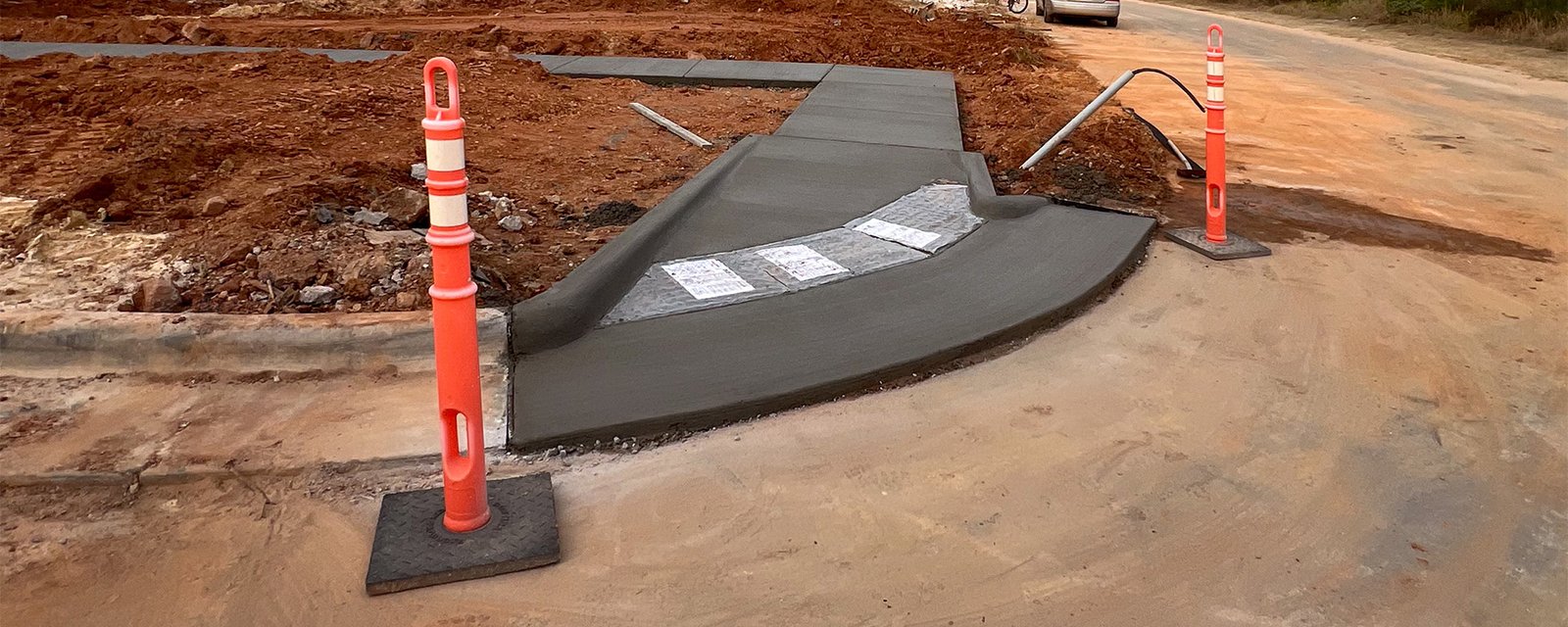
Accessible routes are checked with a level and a tape measure, and they fail on inches. A cross slope of a few tenths of a percent too steep, a curb ramp that lands in a drainage swale or a joint that lifts after a freeze can turn a finished sidewalk into a punch-list item or a complaint. We build site concrete with those tolerances in mind, so the route from the accessible stall to the building entry passes inspection the first time.
The metro has plenty of reasons to care. InterQuest on the far north side has three major commercial centers, and the facilities around it draw both employees and visitors who expect a continuous accessible path. Campuses with long walks, such as the 520-acre University of Colorado Colorado Springs campus on Austin Bluffs Parkway, show how many ramps, landings and crossings a large site accumulates over time. Industrial buildings are smaller, but their obligations are the same.
We work from the approved plan and the reviewing authority's requirements, and we raise conflicts before concrete is ordered. Accessible work is rarely a separate project; it is woven through the parking lot, the building entry and the site utilities, which is why we coordinate it with stabilized parking lots and the building package.
Slopes, Freeze-Thaw and Drainage Around Walks
Sloping ground makes accessible design difficult. Running slope, cross slope and landing size all have limits, and the foothill terrain around the city tends to produce parcels with grade change across the building pad. We use design-grade surveys and check the proposed elevations against the route before the forms go in, because a few inches of fill at the right point can solve what grinding cannot.
Altitude and freeze-thaw cycling are the second concern. Concrete placed in this climate needs air entrainment, careful finishing and curing, and it should not receive deicing salts in its first winter. We specify the mix with the supplier, protect fresh concrete from rapid temperature swings and slope every surface so that water leaves instead of sitting and freezing on a ramp.
Standards and Review
Accessible routes, parking and curb ramps are reviewed by the local building department against the adopted building code and the applicable accessibility standards. Colorado Springs adopted the 2023 Pikes Peak Regional Building Code, which carries the 2021 International Building Code, by Ordinance 23-16, passed March 28, 2023 and effective April 10, 2023, with implementation on June 30, 2023, enforced by the Pikes Peak Regional Building Department. The code sets the number and distribution of accessible stalls and the geometry of routes.
Public right-of-way work, such as a driveway apron or a sidewalk adjoining a street, follows the city's standards and a separate permit. We determine the correct authority for each piece of concrete on a plan and submit the work in the order that avoids duplicate review.
What We Pour and Finish
The package includes sidewalks, curb ramps with detectable warnings, landings, building entry slabs, ADA stall pads, access aisles, curb and gutter, crosswalk ramps, dumpster pads and bollard foundations. We set forms to survey, install reinforcement or dowels where specified, place and finish the concrete and cut control joints at the spacing the design requires, in the first available window.
After pouring, we survey the finished slopes and record them. If an element is outside tolerance, we correct it while the contractor's crew is still on site, rather than waiting for an inspector to find it. Our site concrete often ties into the permanent security fencing and gates where pedestrian gates and operator pads share the same slabs.
Why Managing Concrete Closely Helps Accessibility
Accessibility problems usually appear at the seams between trades: the paver sets a catch basin where a ramp should land, the concrete finisher assumes an elevation the grader did not hit. When one team manages the grading, forming and finishing, those handoffs disappear. One foreman owns the elevations from subgrade to broom finish, and a correction is a conversation across a truck tailgate rather than a change order.
We also bring the equipment to saw-cut, remove and replace failed sections of walk without disturbing the rest of the site, which is helpful when an existing facility needs to be brought into compliance without closing the parking lot. For existing sites with large areas to repair, the demolition and slab replacement trade crews handle the removal.
Pricing Accessible Concrete Honestly
Cost is driven by quantity, the amount of demolition, forming complexity at ramps and landings, the number of mobilizations and how much grade correction the route needs. A flat parcel with a clear plan prices simply. A retrofit with many small repairs does not, since each small pour carries mobilization, forming and testing time.
We bundle repairs into a few planned mobilizations and price them by line item so you can see which repair costs what. If a smaller change achieves compliance, such as regrading a landing instead of rebuilding a ramp, we say so, because the cheaper correct answer is the one we want you to take.
Related Work and Who We Serve
Site concrete connects to nearly every other scope on a facility. It is part of the dock approach and truck court, the entry to an office building and the pedestrian paths of a school or municipal campus. Owners of education and school facilities in particular face a continuous review of accessible routes because the public uses them daily.
Industrial owners in food and beverage plants often add visitor entries and tour routes that need the same care. We carry the same standards across all of them.
Get Accessible Routes Right the First Time
Send the approved site plan and the grading plan, and we will review the accessible route elevations before any concrete is ordered.
Common Questions
What are the most common accessibility failures on new sites?
Cross slopes on walks that exceed the allowed maximum, ramps that land in a drainage path, detectable warnings set in the wrong orientation and stalls whose access aisles slope more than allowed. All of them are avoidable with a survey check before the pour. We check elevations before concrete is ordered, not after it sets.
Can you fix non-compliant concrete without replacing the whole walk?
Sometimes. Grinding can correct small lips and joint offsets, and a single panel can be removed and replaced. When the overall slope is wrong, the walk must be rebuilt. We measure first and tell you which approach is realistic.
How does cold weather affect concrete flatwork here?
Cold weather requires insulating blankets, heated enclosures or accelerated mixes, and it extends curing time. At altitude, daily temperature swings are larger, so protection matters even in fall and spring. We state cold-weather costs in the bid so there is no surprise.
Do you handle the detectable warning surfaces?
Yes. We install the detectable warning units at curb ramps and at other places the plan requires. They are set into fresh concrete to the dimensions and orientation the standard specifies.