
Industrial Construction Along the I-25 Tejon and Cimarron Corridor
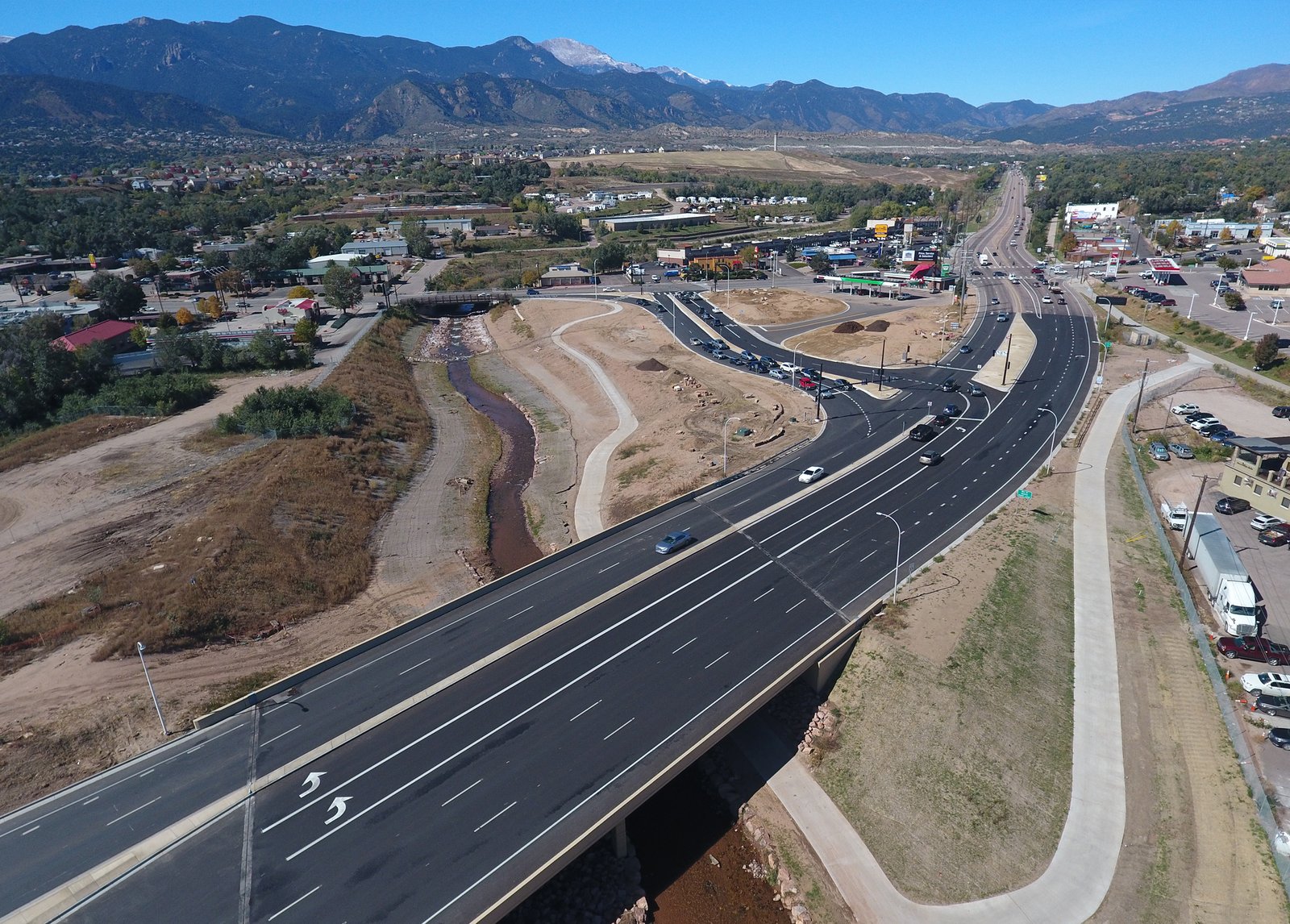
About 100,000 vehicles a day used Interstate 25 through Colorado Springs by 2005, up from roughly 8,500 a day in 1960, and any building beside that traffic has to be built with the highway in mind. The Tejon and Cimarron stretch is where three interchanges meet the center of the metro. We build service, repair, supply and light industrial space here, and we plan every delivery, lift and pour around the traffic that passes the site.
The corridor suits owners who need a central address for contractors, equipment suppliers, repair shops, fleet service and storage. It is close to downtown, it reaches the south side through U.S. 85 and it opens toward the west through Cimarron Street. Sites are usually small, irregular and bounded by roads, drainage and other buildings, which calls for closely managed work and tight scheduling.
We do not try to make a central site into a big-box site. We design buildings that fit the lot, use the height available, keep truck turns within the property and leave room for the next change in use. That approach lowers cost and keeps the project moving.
Sequencing Around Peak Traffic and Closures
Delivery planning is the central skill on this corridor. Concrete trucks, steel haulers and crane mobilizations are scheduled outside peak traffic and cleared with the owner of every adjacent access. When the site depends on a ramp or a frontage road, we confirm closures and lane restrictions with the highway authority before we commit to a pour date.
The COSMIX project between 2005 and 2007 widened I-25 through the city to three lanes each way and rebuilt the Bijou Street and Rockrimmon interchanges. It finished at the end of December 2007, a year and four days early, at about $150 million against an original estimate of $225 million. We cite it for a practical reason: the corridor has been rebuilt before and may be again, so we check for planned work before an owner commits.
Three Exits, Three Directions
Interstate 25 exit 140 serves State Highway 115 south and U.S. 85, exit 141 serves U.S. 24 west (Cimarron Street) toward Manitou Springs and Pikes Peak, and exit 139 serves U.S. 24 east (the Martin Luther King Jr. Bypass). Between them, a site on the corridor can reach the south side, the western foothills and the eastern part of the metro quickly. That is useful for contractors and suppliers that dispatch crews and trucks across the whole area.
The corridor also borders downtown. Owners can link a service yard here to a project in downtown Colorado Springs or to a customer in Manitou Springs, and the trip stays short. Reconstruction of Cimarron Street (U.S. 24 West) at the I-25 interchange was completed in late 2017, which improved the west connection for trucks and vehicles.
Small Lots, Noise and Drainage
A central lot rarely allows a conventional site plan. We fit the building, a truck turn, a few parking spaces and a drainage facility on land that may be a fraction of an acre. This often means a multi-level layout, an underground detention vault or a shared facility with a neighbor, and it always means careful coordination with the city on setbacks and access.
Noise and vibration from the highway affect the building too. Offices and break rooms may need acoustic windows, and sensitive equipment may need isolation from truck-induced vibration. We design the envelope and the floor for those loads and test them during commissioning.
Building With the Highway Beside the Site
We start with a survey of access: where trucks can enter, where they must exit, which turns they cannot make and which streets are restricted. Then we design the building and yard to match, rather than the other way around. The result is often a building that sits at the rear of the lot with a yard in front, or a two-story building that frees ground space for vehicles.
We also protect traffic on the road. Construction entrances are controlled, trucks are not allowed to queue on public streets and a trained flagger manages entry and exit during busy periods. The corridor is a working road, and the site should not become a problem for those who use it.
Older lots bring a further question: what is already in the ground. Former service stations, repair shops and storage yards can leave buried tanks, old foundations or contaminated soil. We recommend an environmental review before purchase and a plan for handling spoil, and we price removal as a separate allowance so a surprise does not reach the owner as a change order.
Services Owners Add to a Corridor Project
Many corridor owners combine a building with truck courts and trailer yards, even when the yard is small. A short court with heavy concrete and a tight radius can serve a fleet of service vans and a few semi-trailers. We also provide long-lead procurement management for equipment such as overhead doors, hoists and electrical gear.
Parking structures are an occasional need on central lots. For owners with large staffs, a parking structure may be the only way to meet code. We coordinate with the structural engineer and the city to design a deck that fits the lot, drains well and holds up in winter.
Share the Address and the Fleet
Send the lot, the vehicle types and the building program. We will check access, drainage and the traffic calendar and suggest a plan that fits.
Common Questions
Can you build on a small, irregular lot?
Yes, and it is common on this corridor. We evaluate the buildable area, the setbacks, the access and the drainage, and then develop a plan that may include a taller building, an underground detention system or shared parking. Some lots are not suitable for the intended use, and we will say so.
How do you manage construction traffic near the interchange?
We schedule deliveries outside peak hours, control the construction entrance and keep trucks off public streets while waiting. For lane closures we obtain permits and give the highway authority notice. Where possible, we group deliveries into short windows.
What should an owner confirm before buying a corridor lot?
Confirm the access rights, because some lots reach the road only through an easement or a shared drive. Confirm the drainage path and whether detention is required on site. Confirm utility locations, since older lines can run under the lot, and confirm the soil and any environmental history of former service uses. Each of these can change the buildable area and the cost, and each can be checked in a few weeks before closing.
Does highway noise change how a building is designed?
It can. We recommend acoustic glazing and insulation for offices and break rooms, and we place quiet functions away from the road when the site allows. For sensitive equipment, we review vibration and design the floor accordingly.
Is the corridor good for distribution?
It is better for local service, repair and supply than for large-scale logistics and distribution. Parcels are small, and truck access can be limited. For larger distribution buildings, we usually point owners to the Powers Boulevard corridor.