
Truck Courts and Trailer Yards for Industrial Sites
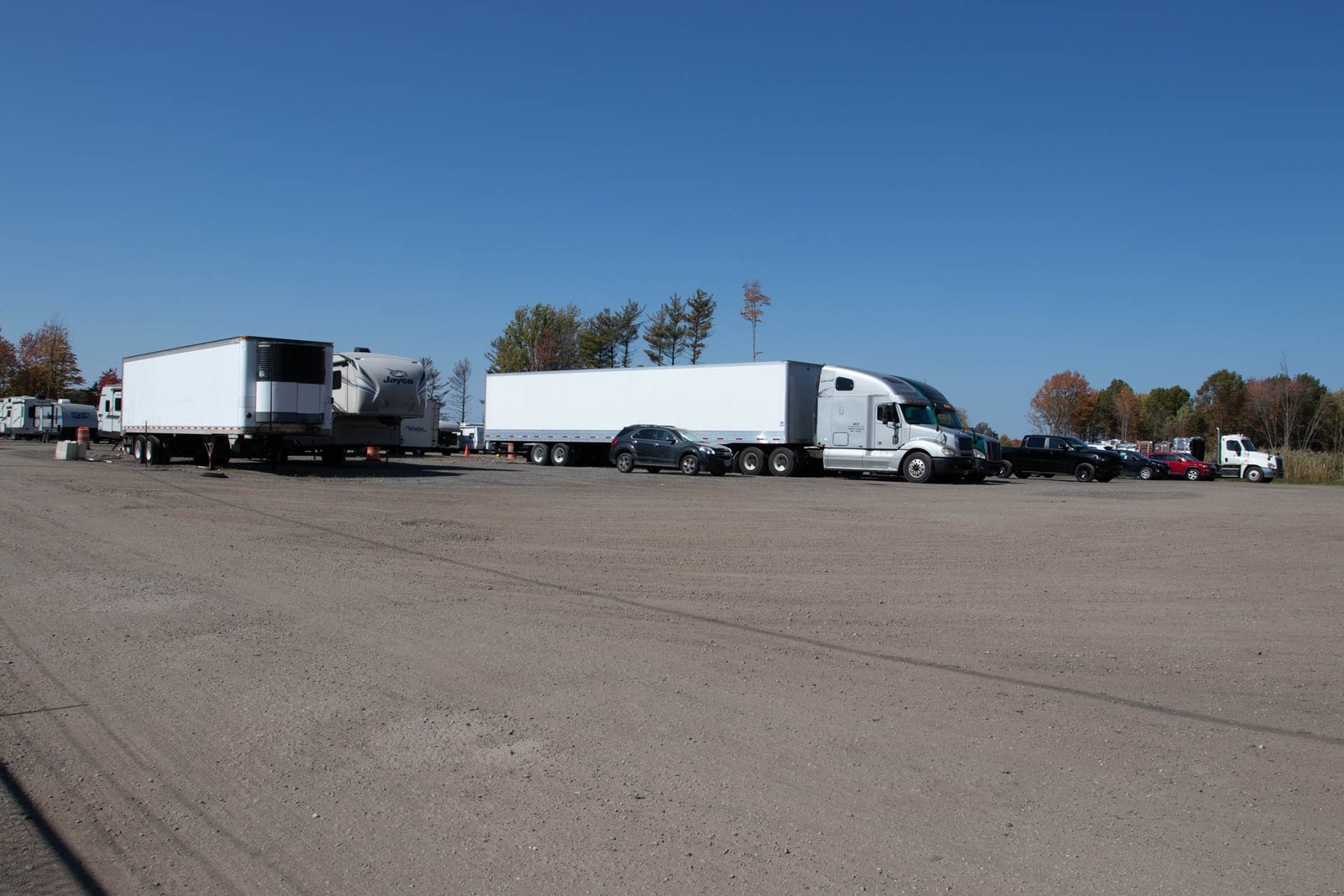
Truck courts fail from the bottom up. A trailer's landing gear and axles concentrate load on small patches of pavement, and a court that looks fine at the ribbon cutting can rut, pump and crack within a few seasons if the subgrade, base and concrete were not built for the traffic. We build truck courts and trailer yards for industrial and distribution sites in the Colorado Springs metro, from the subgrade proof-roll through the last joint seal, sized for the loads and turning paths the operation actually runs.
A court is a system. It includes the dock approach, the maneuvering area, the trailer parking, the drive lanes, the gates and the guard position, all graded to drain without ponding, marked so drivers know where to go and lit so they can see. Pavement choice is made on use: concrete for the dock approach and the parking where trailers stand, asphalt where loads are lighter and the owner values quick repair. The apron at the doors is its own detail, covered under dock aprons and loading zones.
Base and concrete under one plan
We manage subgrade preparation, base placement and concrete paving for truck courts, with testing at each layer. Subgrade is proof-rolled and corrected, base is placed in lifts and compacted, and concrete is placed with dowelled joints sized to the slab thickness and with reinforcement where the design calls for it. Joint layout is planned with the drainage so joints do not sit in the low line.
Control of the work shows in the details: dowel alignment, finish, cure and the timing of joint sawing. At altitude, with dry air and wind, curing is a first-order concern. Concrete dries and cracks early if it is not covered or sprayed, so we plan crews, compounds and blankets around the day's forecast.
Yards along the I-25 and Powers corridors
Truck traffic in the metro follows Interstate 25 and State Highway 21. Powers Boulevard runs 20.245 miles from Fountain to the north side, bypassing the airport, as a 55 mph expressway through eastern Colorado Springs and a 65 mph semi-freeway north of Dublin Boulevard, which makes it a natural freight spine for sites along its length. A yard that takes trucks off that road needs room to queue on site, and our work on the Powers Boulevard corridor starts with a queue analysis.
Interstate 25 serves Monument at exits 158 and 161, and State Highway 105 runs east-west through the town. On January 14, 2025 the Town Council unanimously approved two industrial distribution warehouses in phase 2 of the Falcon Commerce Center, south of Baptist Road and west of I-25. Buildings of that kind put many trailers on the ground, and the court and trailer parking design determines how well the site handles its peak. Monument projects start with the same queue and turning review, as do truck terminals and cross-docks.
Pavement design and the approvals around it
Pavement thickness comes from the geotechnical report and the traffic: the number of trucks, their weights and the soil beneath. The pavement engineer sets the section, and we build it. Where soils are weak, we recommend subgrade stabilization, geotextile or thicker base, and we price the options. Jurisdictions review access, driveway geometry, sight distance and truck turning paths, and we prepare those drawings with the civil engineer.
Drainage is part of the same review. Large paved areas generate runoff that must be detained and treated, so the court and the stormwater detention and drainage design are developed together. Lighting, screening and landscaping requirements for trailer parking are set by local rules, which we check at the start.
Layout decisions that last
A truck court is the layout decision that cannot be changed later. We test turning paths with the largest vehicle the operation expects, set the dock approach depth with room for the trailer plus the maneuvering distance, and arrange entries so outbound and inbound traffic do not cross. Trailer parking is planned for the peak, not the average, with a count for drop trailers and expansion room reserved. Operators in logistics and distribution feel the cost of a wrong guess here most.
Security shapes the layout as much as geometry does. A controlled gate needs queuing room off the public road, a guard position with sight lines, vehicle inspection space and separation between employee and visitor flows. For secured sites we plan the inspection lane, barrier and lighting with the owner's security staff, and we coordinate the work with fencing and security integration.
Pour season and sequence
Truck court paving is placed after underground utilities are tested and the building is dried in, but it often cannot wait long past that, because trucks need the yard for deliveries and the owner needs the dock operational. We schedule subgrade and base for the dry season and the concrete for temperatures that allow proper placement and curing, with winter protection for the shoulder months.
We maintain a temporary construction surface, usually compacted aggregate, during building construction, and protect the finished base from the heavy loads of steel and concrete deliveries. Where the owner wants permanent surfaces early, the approach follows our stabilized parking lots methods. Final paving is coordinated with dock equipment, bollards, striping and light poles so those items are not cut into new concrete later.
Size the yard for the peak day
Tell us the trailer counts, the largest vehicle and the gate rules. We will return a court layout with pavement options, drainage and a pour schedule tied to your dock date.
Common Questions
Should the truck court be concrete or asphalt?
Concrete is the usual choice at the dock approach and wherever trailers stand for long periods, because it resists the point loads of landing gear and the softening of asphalt in heat. Asphalt can serve for lighter lanes and employee parking and is quicker to repair. The pavement engineer makes the final call from the loads, and we price both.
How deep should the dock approach be?
Deep enough for the trailer plus the maneuvering distance for the largest vehicle the operation expects. The turning path analysis sets the number. Too shallow a court forces drivers to make multiple moves, slows the dock and damages the pavement edges.
How do you control cracking in a large slab?
With a good subgrade, dowelled and well-spaced joints, correct curing, and sawing at the right time. Cracking is managed rather than eliminated, and the aim is for it to occur at the joints. We also coordinate the joint layout with the drainage so water does not collect on the joint lines.
Can the yard be built before the building is finished?
Parts of it can. Underground work, base and sometimes paving at the entry can be done earlier, but heavy construction traffic can damage finished pavement. We usually place the final surface late, and use temporary aggregate during building construction.